The Artist · Pricing and Pay
The shoot lasts one day, yet the job took five. You spent two days pulling, one day fitting, a long day on set and another day driving returns across town. Then the producer asks for your stylist day rate, and you realize the number you quote has to carry all of it. This guide is for working stylists who bill commercial, editorial and e-commerce clients, and it treats pay as a set of separate lines rather than one figure. If you are still mapping the field, start with what each type of stylist does, because an editorial booking and a catalog booking price very differently. Here, we stay with the money: prep, returns, kit, overtime, usage, invoices and payment terms, each tied to a named source you can check.
The short answer
A stylist day rate pays for one shoot day of your time and judgment. In published production estimates from Wonderful Machine, wardrobe stylists appear at roughly $900 to $1,100 per day, with assistants at $400 to $500. Prep, shopping, fitting and return days usually appear as separate lines. Kit fees, the wardrobe budget, overtime and expenses also sit outside the rate, so quote them separately and put payment terms in writing.
In this guide
- How a stylist day rate is built
- Prep days, fit days and shopping days
- Return days and the cost of holding pulls
- Kit fees, wardrobe budgets and expenses
- Usage fees and where the stylist fits
- Overtime, travel days and cancellations
- Writing the stylist invoice
- Setting your own stylist day rate
- The quote as a record of the work
- Questions worth asking
How a stylist day rate is built
Most commercial clients budget crew by the day, so your first number is a day rate. However, the rate only covers the shoot day itself, and producers know that. For a reference point, look at Wonderful Machine’s 2024 hair-care brand estimate on A Photo Editor. There, producer Bryan Sheffield budgeted a wardrobe stylist at $1,100 per day and an assistant at $500 per day. The same estimate set aside a separate wardrobe budget for two outfits per talent. In other words, your fee, your assistant and the clothes all sat on different lines. That structure matters, because each line can move on its own during negotiation. A client who trims the wardrobe budget has not touched your stylist day rate, and you should not let the two blur together.
A second estimate shows how much the number can vary. In a 2023 Wonderful Machine bid for a medical device maker, the wardrobe stylist came in at $900 per day. That job needed simple scrubs, gowns and footwear for five models, so the wardrobe allowance was modest too. Still, a stylist day rate in one estimate is a single data point for a single job, not a rate card. Your market, the client’s size, the usage and the complexity of the wardrobe all push the figure up or down. Treat published estimates as evidence of how producers think, rather than a ceiling or a floor. In practice, the most useful lesson is structural. Producers expect a stylist to arrive with a rate for the shoot day and a clear list of everything else the job requires.
Pricing the assistant
Assistants deserve their own line, and you should never absorb them into your fee. The 2024 hair-care estimate paired the stylist with a $500 assistant. Meanwhile, a 2026 estimate on A Photo Editor, discussed below, booked a wardrobe assistant at $400 per day for one prep day and two shoot days. Those figures tell you two things. First, producers expect assistant costs to appear on the bid. Second, the assistant often works prep days as well as shoot days, so count those days when you build your quote. If you hide the assistant inside your own rate, the client sees a high stylist fee and pushes back. By contrast, a separate line shows the real labor the job needs. It also protects your assistant, who then has a documented rate and schedule rather than an informal favor.
P6C Plus Rolling Rack with Cover — protected pulls in transit
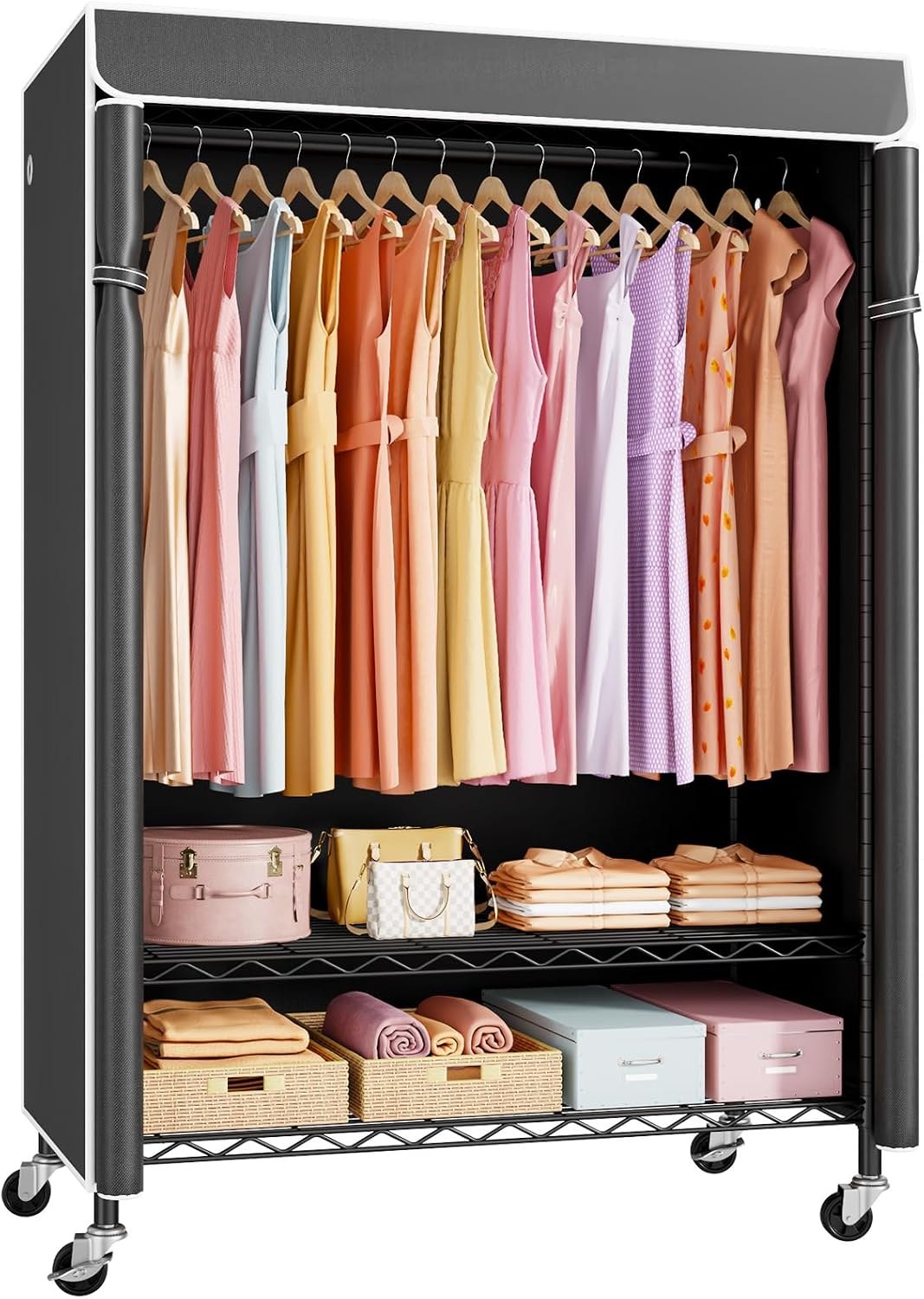
Prep and transport time belongs in a day rate, and good equipment keeps those hours predictable. The P6C Plus Rolling Clothes Rack with Cover is a rolling garment rack with a zip-up cover. Because the cover zips closed, pulls stay protected between showroom, studio and returns. In practice, it suits stylists who move a full pull by van or freight elevator. It also makes your prep visible, which helps when you explain to production why a prep day is billed. Then load the rack in shot-list order, so dressing starts quickly on set. As a result, the hours you quote match the hours you work.
Prep days, fit days and shopping days
Prep is paid work, and the clearest estimates treat it that way. In Craig Oppenheimer’s 2012 estimate for a clothing retailer, the stylist’s own quote listed shoot-day fees and prep-day fees separately. The producer then budgeted four prep days for that stylist. Two days went to sourcing props, and two went to preparing clothes in the studio. On top of that, the stylist attended a fit day with the client and agency to review the clothing. So a two-day shoot carried at least five non-shoot days for styling alone. Notice where the breakdown came from, too. The stylist supplied it. When you itemize your own days, the producer can defend each one to the client, and you avoid being cut back to the shoot days only.
The ratio of prep to shoot days can be lopsided. For example, a 2015 Wonderful Machine estimate for an in-store retail shoot gave the wardrobe stylist three shopping days for one shoot day. The assistant helped shop on two of those days, worked the shoot and then handled the returns. Similarly, the 2026 estimate gave a prop stylist five prep days, six shoot days and two wrap and return days. Across these jobs, the shoot day is often the smallest share of the work. That is why a stylist who quotes only the shoot ends up underpaid. You can bill prep at the full day rate, or you can set a reduced prep rate. Either approach can work, provided the quote names the days and the rate for each.
When the client supplies the clothes
Sometimes the client provides every garment, and the prep load shrinks. In a 2022 estimate for an apparel company’s ambassador portraits, the client supplied all the apparel. Even so, the producer booked a wardrobe stylist for the pre-light day as well as the shoot day. That pre-light day is worth noticing. It gave the styling team time to review the wardrobe on the talent before the cameras rolled. If a client says the clothes are handled, ask whether there is a fitting or pre-light day, and price it. Steaming, tailoring fixes and fit notes still take hours. Then, list a short prep window for receiving and checking the client’s garments, because damaged or missing pieces become your problem on set unless someone logged them first.
Fit days also carry a hidden cost: they compress your schedule. When a fitting lands two days before the shoot, any changes trigger more shopping, more alterations and sometimes a tailor. The 2012 retailer estimate, for instance, had the stylist bring an assistant and a tailor to alter clothing. So ask early who pays for alterations and whether a tailor sits on your line or the production line. Also, decide how you bill a fit day that runs short. One clean rule is to treat any booked day as a full day, because the booking blocks other work. Whatever you choose, state it in the quote. As a result, nobody argues later about whether a three-hour fitting counts as a half day, and the producer can plan the budget with fewer surprises.
Return days and the cost of holding pulls
Returns are the day most stylists forget to bill. Yet the estimates above budget them openly. In the 2012 retailer job, the stylist assistant handled the returns. In the 2015 retail shoot, the assistant returned the wardrobe after the shoot. Then, in Bryan Sheffield’s 2026 estimate for a lost commercial bid, the prop stylist carried two wrap and return days and the prop assistants did too. Returns take time because every piece needs checking, steaming, re-tagging and logging against the pull sheet. Some pieces go back by courier, and others need a showroom drop. Because the work is real, it belongs on the quote as its own day. It also connects to your exposure on liability for pulled samples, which can cost far more than a day’s fee.
Rongta Bluetooth Label Printer — tagged parcels for return day

Return days run faster when every parcel and bag is labeled before the courier arrives. The Rongta Bluetooth Label Printer is a wireless thermal printer for parcel and tag labels. Because it connects over Bluetooth, you can print return labels and garment tags straight from your phone. In practice, label each bag with the brand, the PR contact and the return date. Then match those labels to your pull sheet before anything leaves the studio. It suits stylists who return to several brands in one day. As a result, fewer pieces go astray, and the return day you bill stays as short as planned.
Holding pulls also costs money while you have them. If a showroom or store holds your card on file, your own money stays at risk until every piece is back. So build the return window into your schedule, and confirm the return dates with the producer before you pull. Courier fees, return shipping and parking for showroom drops are expenses, not part of your fee. Bill them as actual costs with receipts attached. Meanwhile, keep your pull sheet current during the shoot, because a missing belt discovered a week later is hard to trace. If the job runs long and you must keep pieces past the agreed date, tell the producer in writing. That way the extra hold, and any extra return day, becomes an approved change rather than a quiet loss you absorb yourself.
Kit fees, wardrobe budgets and expenses
Your kit wears out, and a kit fee is how you recover that cost. Fashion tape, clamps, pins, lint rollers, steamer parts and shoe covers all get used up on set. Producers recognize this. In a 2021 estimate for a vacation company, Craig Oppenheimer added some padding to the styling budget for kit fees and shopping expenses. That estimate also priced wardrobe at $250 per outfit, with two outfits for each of six talent. So the kit fee sat beside the wardrobe allowance, not inside the stylist’s day rate. In practice, you can charge a flat kit fee per shoot day. Alternatively, you can bill consumables at cost. Either way, name the fee in your quote, and keep it modest and consistent so producers see it as routine.
Keeping the wardrobe budget separate
The wardrobe budget is a third, separate pot of money. It covers the clothes you buy or rent for the shoot, and it should never come out of your fee. The 2026 estimate set wardrobe for two looks on a single talent at $800. The 2024 hair-care estimate allowed $1,600 for two outfits per talent and marked it as pending final creative. Likewise, the 2015 retail estimate started from a per-person allowance and then rounded up for a buffer. Because these sums can be large, ask for a cash advance or a production card before you shop. Then keep every receipt, and return unworn purchases promptly. Your records also matter at tax time, and our guide to deductible kit and travel costs explains how to track them.

Notes for working stylists: pulls, pricing, clients and career, sent occasionally.
Occasional letters. Unsubscribe anytime.
Expenses beyond wardrobe and kit deserve the same discipline. Mileage, parking, couriers, tailoring and meals while shopping can add up across a multi-day job. So list the categories you expect in your quote, even if you cannot give exact figures yet. Then the producer can approve a cap, and you can bill actual costs against it. Also, decide early whether you need an advance. A stylist who fronts a large wardrobe budget on a personal card carries real risk if payment runs late. For that reason, it is reasonable to ask for wardrobe funds before the first shopping day, with the fee itself due on normal terms. Keep expenses on a separate tab of your invoice, too. That way a dispute over one receipt does not hold up payment of your day rates.
Usage fees and where the stylist fits
Usage is the fee a client pays to use images in particular media for a set time. In photo estimates, licensing attaches mainly to the photographer and the talent. For instance, a 2019 estimate for a fashion brand’s real-people lifestyle shoot priced web use of up to 30 images for one year. It used a sliding fee per image for each subject, plus a creative fee per shoot day. Later, the producers priced a two-year option at an extra 50 percent of the one-year fee. Then, when the 2024 hair-care client wanted to expand usage after delivery, the new fees and agreements applied to the photographer and the two talent. The wardrobe line, by comparison, stayed a simple day-rate line in both of those estimates.

So what does usage mean for you? In these estimates, the stylist bills time, and usage rarely appears on the styling line. That is the norm to expect, not a rule you must accept. If a job involves broadcast, out-of-home or perpetual use, you can ask for a higher rate or a usage clause before you sign. However, raise it at the quote stage, because nobody reopens a crew rate after the shoot. Credit is a related issue. When an editorial job pays little, the credit line and the tear sheet carry much of the value. For that side of the business, see our piece on usage and credit lines. Meanwhile, keep a record of where each image ran. That record supports both your book and any later fee conversation.

Overtime, travel days and cancellations
A day needs a defined length, or overtime becomes an argument. So state your day in hours, and state your overtime rate, in the quote itself. The 2024 hair-care estimate shows why. During the shoot, client requests and delays pushed the crew toward about two hours of overtime. The producer got the agency to approve those costs on set, and then included the overages in the balance invoice. That sequence is the model to copy. When overtime starts, tell the producer, get a written yes and note the time. Then bill it as its own line with the hours shown. A text message counts as a record, though an email is cleaner. Without approval on the day, overtime often turns into a favor you never recover, especially on larger crews.
Travel days and half days also need rules. If a job sends you out of town, the travel day blocks your calendar just as a shoot day does. So bill it as its own line, either at a travel rate or at a set share of your day rate. Cancellations matter even more, because a cancelled shoot can wipe out days you turned down elsewhere. So set a deposit, a cancellation window and a kill fee in writing before you book. The language does not need to be complicated. Our guide to deposit and cancellation wording was written for makeup artists, yet the clauses translate directly to styling bookings. Adjust the timeline to cover prep days already worked.
Writing the stylist invoice
A clean stylist invoice mirrors the quote line by line. Start with your name, business details, the client, the job name and any purchase order number. Then list each type of day separately: prep, fit, shoot, return and travel, each with its date and rate. Add the assistant, the kit fee and any approved overtime with hours shown. After that, list wardrobe actuals and expenses with receipts attached, ideally as a separate schedule. Finally, show the total, the payment due date and how to pay. Because producers often reconcile invoices against the original bid, matching the bid’s structure speeds approval. It also makes errors easy to spot. When a line differs from the quote, add a short note explaining the change and who approved it on the day.
Epson WorkForce ES-50 — receipt backup for every invoice

Every invoice line needs proof, and paper receipts fade or vanish quickly. The Epson WorkForce ES-50 Mobile Scanner is a compact, lightweight scanner for documents and receipts. Because it is small, it can live in your office and travel to longer jobs. In practice, scan each wardrobe receipt on the day of purchase, then file it by job and date. It suits stylists who invoice production for purchases, returns and kit fees. Then attach the scans to the invoice, so the client can check each line without asking. As a result, the client has fewer reasons to query a line, and payment moves on.
Net terms deserve the same care as the rate. Some states and cities now set rules for freelance pay. In New York City, the Department of Consumer and Worker Protection’s freelance worker rights page explains the Freelance Isn’t Free Act. Contracts worth $800 or more, including several with one client inside 120 days, must be in writing. The contract must describe the work, the pay and the due date. If no date appears, payment is due within 30 days after you finish the work. Late payment can bring double damages. Statewide, the New York State Department of Labor’s Freelance Isn’t Free Act page notes that a state version took effect on August 28, 2024, with a model contract you can use.

Taxes change what your day rate is really worth. Clients who pay you as a contractor report that income on Form 1099-NEC. The IRS instructions for Forms 1099-MISC and 1099-NEC now set the box 1 threshold at $2,000 of nonemployee compensation. Still, you owe tax on all of your income, whether or not a form arrives. On top of income tax, the IRS self-employment tax page sets that tax at 15.3 percent, covering Social Security and Medicare. As a result, a $1,000 day is not $1,000 of take-home pay, even before expenses. So set aside a share of every payment as it lands. Then track receipts all year, because the kit, travel and wardrobe costs you document can reduce what you owe.
Setting your own stylist day rate
Your number comes from your days, not from a single figure you heard somewhere. Start with the shoot day rate you can defend for your market and client type. Then count the prep, fit, return and travel days the job truly needs, and price each one. Add the assistant, the kit fee and a wardrobe budget estimate. Finally, check the total against what the client can spend, and adjust scope before you adjust your rate. Stylists price differently from makeup artists because prep and returns multiply the days. Even so, comparing notes helps, and our guide to how makeup artists price their work shows a related approach. Over time, your stylist day rate should rise with your book, while the structure of your quote stays the same.

The quote as a record of the work
A good quote does more than set a price. It shows the client what styling actually involves, from the showroom pulls to the last courier drop. Many clients have never seen that work, because it happens before and after the shoot. When you itemize it, you make it visible, and you give the producer the language to defend it. That also changes the conversation. Rather than asking whether your rate is too high, the client asks which days they can live without. Sometimes the answer is fewer looks or a client-supplied wardrobe, and that is a fair trade. Either way, you stop absorbing unpaid days. Over a year, those recovered prep and return days often matter more than any increase in the rate itself.
Tools and library


The tools above keep the physical side of a job in order, from the rack that carries your pulls to the scanner that holds your receipts. The business side needs the same kind of system. A stylist who tracks days, pulls, expenses and payment dates in one place can quote faster and invoice sooner. That system also shows patterns over time. You may notice that one client always adds a fit day, or that another pays late. With that knowledge, you can adjust your terms for each client rather than guessing. If you want a fuller framework for running styling as a business, the resource below collects the planning tools and career guidance we recommend for independent artists. It covers rates, contracts, client records and the habits that keep a freelance practice steady between bookings.
From the Artist Library
The career guide in the Artist Library was written for makeup artists, yet its chapters on pricing, contracts, agencies and the first five clients translate directly to styling work. Read it alongside your rate sheet and loan paperwork, and it will help you ask sharper questions before your next booking.
Questions worth asking
What is a typical stylist day rate for commercial work?
Published Wonderful Machine production estimates show wardrobe stylists budgeted at about $900 to $1,100 per day, with assistants at $400 to $500. These figures come from single jobs, so your market, the client and the usage can move the number. Use them as reference points rather than a fixed rate card.
Do stylists charge for prep days?
Yes. Production estimates commonly list prep, shopping and fit days as separate lines from the shoot day. One clothing retailer estimate budgeted four prep days plus a fit day for a two-day shoot. Name each prep day in your quote, along with the rate you charge for it.
What is a kit fee for a stylist?
A kit fee covers the consumables and wear on your styling kit, such as fashion tape, clamps, pins and steamer parts. Producers sometimes add it as its own budget line. You can charge a flat fee per shoot day, or you can bill consumables at cost with receipts attached.
Do stylists get usage fees?
Usually not in standard commercial estimates, where licensing attaches to the photographer and the talent. In those estimates, the stylist bills for time instead. If a job involves broadcast, outdoor or perpetual use, you can ask for a higher rate or a usage clause, but raise it before you sign.
When should a client pay a stylist invoice?
Payment should follow the due date in your written contract. In New York City, contracts of $800 or more must be in writing, and payment is due within 30 days after the work ends if no date appears. Agree on net terms before the job and print them on the invoice.
Should the wardrobe budget come out of my day rate?
No. The wardrobe budget pays for clothes you buy or rent for the shoot, and it sits on its own line. Ask for an advance or a production card before you shop. Keep every receipt and return unworn pieces promptly so the final reconciliation stays simple.
